White noise apps are among the most-downloaded sleep tools in the UK App Store. Millions of people fall asleep every night to rainfall sounds, static, or ocean waves. But a study published in the journal Sleep in February 2026 found that pink noise at just 50 decibels (roughly the volume of a quiet conversation) was associated with nearly 19 fewer minutes of REM sleep per night. Participants who wore earplugs, by contrast, recovered 17 of the 23 minutes of deep sleep they’d lost to traffic noise. If your white noise machine is leaving you tired, this explains why.
This guide draws on peer-reviewed research, including the February 2026 University of Pennsylvania Perelman School of Medicine study published in Sleep, and certification data for earplug noise reduction testing. Our recommended pick was selected based on independent certification, side-sleeper comfort, and verified UK customer reviews.
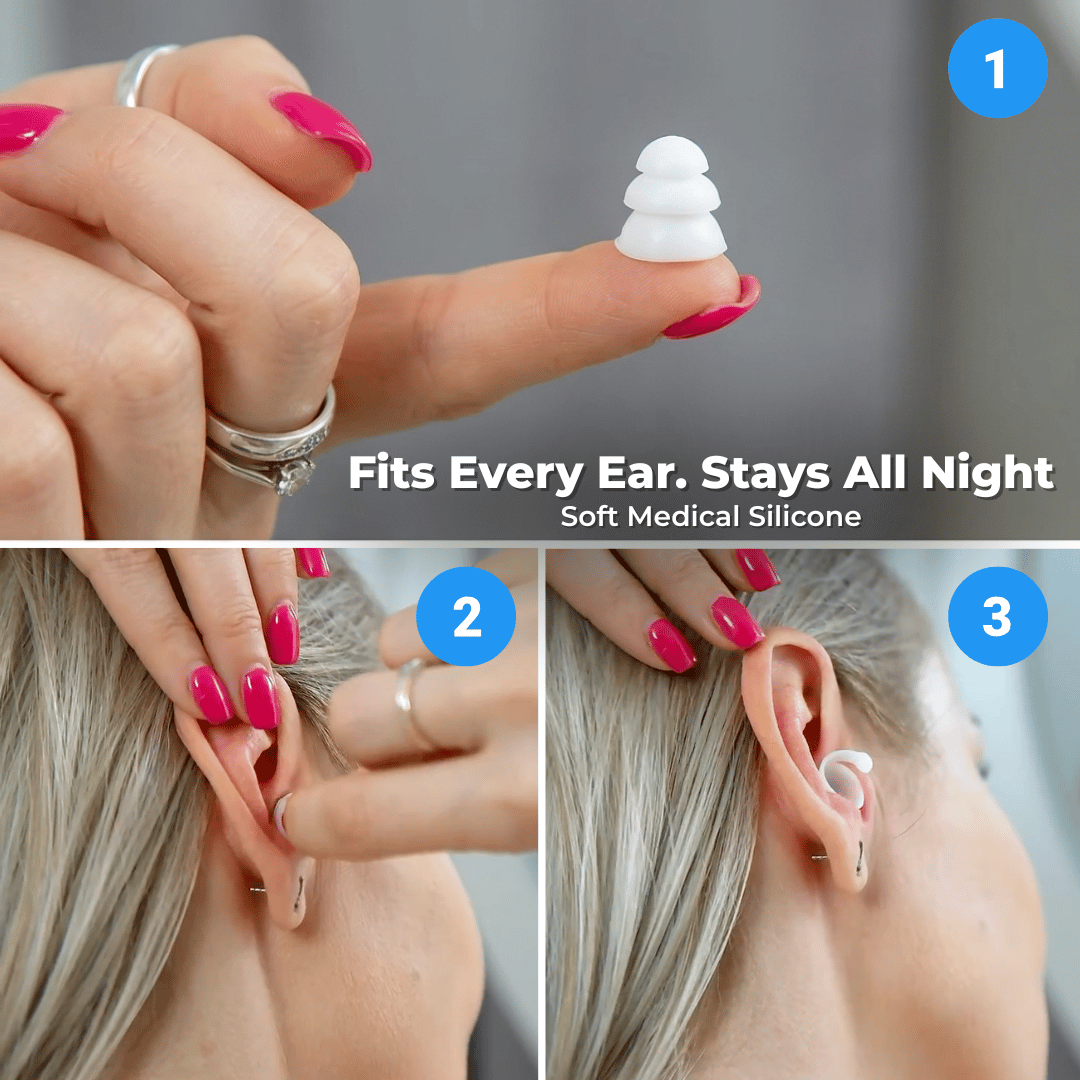
BOLLSEN Life+ Earplugs for Sleeping
★ Our Top Pick — Best overall · side sleepers · snoring partners
BOLLSEN is a hearing protection specialist whose products are independently tested and certified in Germany. Their Life+ is designed specifically for sleep: a patented conical two-lamella design in medical-grade silicone that sits flush with the ear, low-profile enough that side sleepers don’t feel it pressing into a pillow overnight. Independently certified at 24 dB noise reduction by PZT GmbH (NANDO-listed Notified Body No. 1974), it reduces snoring and traffic noise without blocking alarm frequencies. Reusable up to 100 times, with over 10,000 verified reviews.
BOLLSEN Life+
£26.95
++ Today only: Free shipping to the UK / EU ++
www.bollsen-hearingprotection.com
- Independently certified 24 dB noise reduction (PZT GmbH, Notified Body No. 1974)
- Low-profile flush fit, no discomfort when sleeping on your side
- Blocks snoring and traffic noise; still passes alarm frequencies
- Reusable up to 100 times. Washable. Includes aluminium travel case
- 40-day money-back guarantee
- Over 10,000 verified reviews
- Takes 3–5 nights to adjust if you’ve never worn earplugs before
- Not designed for high-noise industrial environments
1. Understand What White Noise Actually Does to Your Brain During Sleep
White noise works by raising the background sound level in your bedroom. A continuous noise floor masks the sudden spikes (a door slamming, a car horn, a partner shifting) that jolt you awake. In that narrow sense, it can help. But masking disruptive sounds isn’t the same thing as protecting your sleep architecture.
Sleep happens in cycles: light sleep, deep sleep (N3), and REM. The deepest stages are also the most vulnerable to disruption. Your brain doesn’t switch off from sound while you sleep. It keeps monitoring the acoustic environment, and any sound (including a white noise machine) generates low-level neurological activity all night. The question is whether that cost outweighs the benefit.
2. What the 2026 Penn Medicine Study Actually Found
In February 2026, researchers at the University of Pennsylvania Perelman School of Medicine published findings in the journal Sleep that challenged the white noise consensus. The study tracked 25 healthy adults across seven nights in a sleep lab, with each participant experiencing silence, traffic noise, pink noise, and combinations of those conditions.
Participants exposed to aircraft noise lost around 23 minutes of N3 deep sleep per night. Wearing earplugs alongside the traffic noise recovered 17 of those 23 minutes. Pink noise at 50 decibels, marketed as “soothing” and roughly equivalent to moderate rainfall, was associated with 18.6 fewer minutes of REM sleep per night. Combined with aircraft noise, pink noise worsened deep sleep, REM sleep, and time spent awake.
The researchers’ conclusion was straightforward: earplugs were significantly more effective than sound machines at protecting sleep against environmental noise. Adding noise to cover noise wasn’t a neutral trade-off. It came with a measurable cost to the sleep stages where memory, mood, and physical recovery are processed.
3. Understand Why Earplugs Work Differently, and Better
Earplugs don’t add anything to your acoustic environment. They reduce what reaches your eardrums. A well-fitted pair rated at 24 dB doesn’t just muffle loud sounds; it shifts your entire noise baseline downward, so the spikes that would otherwise wake you either disappear or drop below the threshold your sleeping brain registers as a threat.
Earplugs are passive. They produce no sound, require no power, and give your auditory cortex nothing to process. That’s why the Penn Medicine study found them so effective: they removed the disruption without creating another one.
There’s also a frequency problem with white noise. Low-frequency sounds (snoring, traffic rumble, bass from a neighbouring flat) are the hardest to mask because a consumer sound machine’s speaker can’t produce effective counter-frequencies at those wavelengths. A properly rated passive silicone earplug brings the overall volume down to a safer level, including that stubborn low end. The BOLLSEN Life+ is a passive silicone earplug rated SNR 24 dB, and it pulls down the low-frequency rumble where snoring and road traffic are concentrated — you still hear those sounds, just quieter, without the underwater muffle of foam.
4. Know When White Noise Might Still Have a Place
The research doesn’t say white noise is universally harmful. It says the trade-off may not be worth it for most people, and that earplugs protect deep sleep more reliably. There are situations where some ambient sound genuinely helps — for people who find complete silence uncomfortable, or for very young children who settle with consistent background sound.
If you use white noise to mask occasional sharp sounds in an otherwise quiet bedroom, and those sounds are high-frequency, there may be a modest benefit. But if you’re dealing with low-frequency noise (snoring, traffic, bass), a white noise machine probably won’t work anyway, and the Penn Medicine findings suggest the continuous exposure may be making things worse.
5. Choose Earplugs Designed for Sleeping, Not Construction Sites
Not all earplugs work for sleeping. The disposable foam cylinders from chemists are designed for industrial environments. They’re high-attenuation (often rated 30+ dB), so they block too much, including alarm frequencies. They also compress and expand as you move, causing discomfort after a few hours. They’re single-use, not washable, and genuinely uncomfortable for side sleepers.
Sleeping earplugs are built around different priorities. A low-profile fit that doesn’t dig in when lying on your side. Selective attenuation that reduces low-frequency noise (snoring, traffic) while still passing high-frequency sounds like alarms. And medical-grade materials that don’t irritate the ear canal with repeated overnight use.
When choosing earplugs for sleep, the most important credential is independent third-party testing. Manufacturer-run NRR/SNR ratings aren’t auditable. Look for testing by a NANDO-listed Notified Body, the same standard required for EU and UK medical device certification. The BOLLSEN Life+ is certified by PZT GmbH (Notified Body No. 1974), with over 1,700 individual tests behind its 24 dB rating.
6. Consider the Combination Approach, But Sort Your Earplug Fit First
The Penn Medicine research suggests that combining earplugs with a low-level sound environment may help in severe cases, such as a loudly snoring partner in a flat beside a busy road. The researchers’ caveat: sound level matters. Anything above roughly 50 dB starts producing measurable sleep disruption on its own.
If you do combine both, keep the sound machine well below conversational level, closer to a very quiet fan than rainfall. Get the earplug fit right first. A poorly fitted earplug won’t seal regardless of what else you’re doing. BOLLSEN offers a free online fit service called AR KI TECH. Upload two photos of your ears and the AI finds the right size before you order. Returns from AR KI TECH orders run at 3%, against an industry average of around 15–20%.
Most people who switch from a white noise machine to a well-fitted pair of certified sleeping earplugs say the adjustment takes three to five nights. After that, the quiet feels natural. Given that the alternative may have been costing you nearly 20 minutes of REM sleep per night, three nights of adjustment is a reasonable price.
The science backs earplugs. Try the independently certified pair with over 10,000 verified reviews, risk-free for 40 days.
Frequently Asked Questions
Is a white noise machine bad for your sleep?
It depends on your noise environment and the volume you run it at. A February 2026 University of Pennsylvania study found that pink noise at 50 decibels (common in white noise apps) was associated with nearly 19 fewer minutes of REM sleep per night. White noise isn’t harmful for everyone, but the trade-off is more significant than most people assume, especially if protecting deep sleep is the goal.
Are earplugs better than white noise for sleeping?
In most cases, yes. The 2026 Penn Medicine study found that earplugs recovered 17 of 23 minutes of deep sleep lost to traffic noise, outperforming pink noise on every measured sleep quality indicator. Because earplugs are passive (they reduce noise without adding any), they protect sleep architecture without the neurological overhead a running sound machine produces all night.
Can you use earplugs and white noise together?
Yes, and for very noisy environments this combination can help. Keep the sound machine well below 50 dB, around the level of a very quiet room. The earplugs do the heavy lifting on attenuation; the background sound handles residual intermittent noise. Sort out the earplug fit first though. If the seal isn’t right, nothing else will matter.
What is the best way to block noise when sleeping?
Certified sleeping earplugs, fitted correctly, have the strongest evidence behind them. Look for independently tested noise reduction ratings (not manufacturer self-certification), low-profile design for side sleepers, and medical-grade materials. Blackout curtains and door seals help reduce external noise entering the room, and both work well alongside earplugs.
Do earplugs block snoring?
Yes. Snoring sits primarily in the low-frequency range (roughly 40–300 Hz), and certified silicone sleeping earplugs attenuate across this range well. A 24 dB attenuation means a 70 dB snore reaches your ears at around 46 dB, below the threshold at which most people fully wake. Very loud, close-range snoring can still register, but most people with snoring partners report significantly better sleep within a week.
Is it safe to use a white noise machine every night?
At safe volume levels (under 50–60 dB), a white noise machine every night won’t damage your hearing. The concern from the 2026 research isn’t hearing damage but sleep quality, specifically the reduction in REM sleep from continuous overnight sound exposure. Whether that trade-off makes sense depends on your noise environment and how your sleep actually responds.