

Most tube commuters assume the noise is unpleasant but harmless. It’s only 20 minutes each way, so how bad can it be? On the Victoria line, between Green Park and Victoria, ambient noise averages 92.9 dB and peaks at 112.3 dB. Sustained daily exposure at those levels causes permanent hearing loss within 18 months for roughly half of those exposed, according to data cited by London Business News and THIIS Magazine from Transport for London measurements.
The frustration leads to a familiar response. Turn up the headphones. That adds 85–90 dB of headphone output on top of 90+ dB of ambient noise, pushing total ear exposure well above any safe limit. One commenter on a HuffPost article on tube noise put it plainly: “I already blast my headphones to drown out the noise.” It compounds the problem rather than solving it.
This guide covers which lines are loudest and why, how daily exposure builds across a full commuting day, and what type of protection actually works on the tube without cutting you off from announcements or the world around you.
Researched using published TfL measurement data, peer-reviewed PubMed studies on noise-induced hearing loss, and recent SW Londoner reporting (February 2026) on line-by-line decibel figures. No product was tested by this editorial team. Product specifications are drawn from manufacturer data and independent certification results.
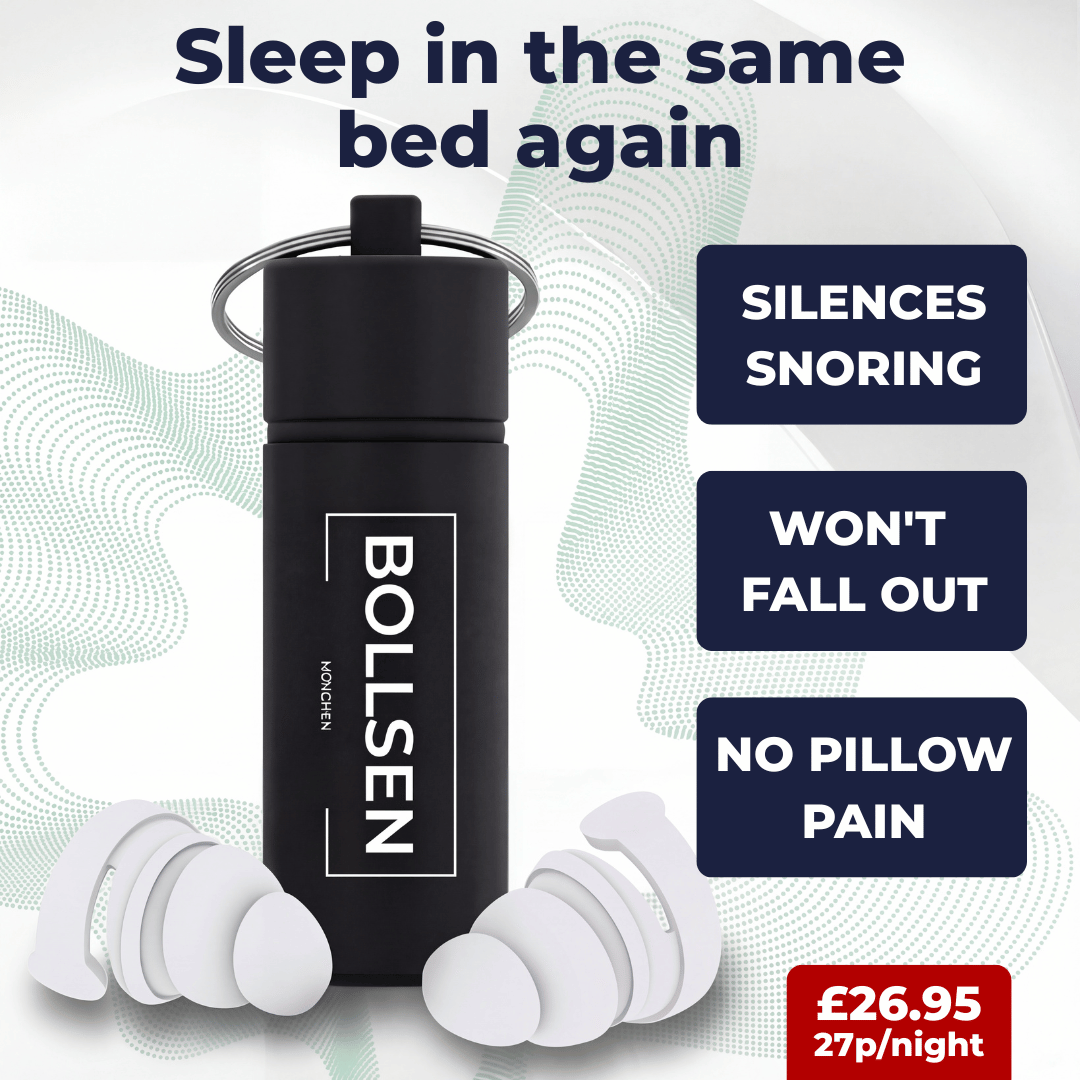
BOLLSEN Life+ Earplugs
★ Our Top Pick — Best for tube commuting and daily noise exposure
BOLLSEN is a hearing protection specialist, independently tested and certified in Germany. The Life+ is a passive silicone earplug that brings the overall volume down to a safer level by a certified 24 dB SNR, without the underwater muffle of foam. Station announcements and safety alerts stay audible because they’re loud and close — you still hear them, just quieter. That’s the key difference from foam earplugs, and it matters on the tube.
BOLLSEN Life+
£26.95
++ Today only: Free shipping to the UK / EU ++
www.bollsen-hearingprotection.com
- Certified 24 dB SNR SNR — independently verified by PZT GmbH (Notified Body No. 1974, NANDO-listed) across 1,700+ tests
- Passive silicone brings the volume down to a safer level — station announcements stay audible because they’re loud and close
- Up to 100 reuses — washable with water and mild soap, includes aluminium travel case
- Medical-grade silicone: BPA-free, PVC-free, latex-free, hypoallergenic
- Trusted by 1,000,000+ people, over 10,000 verified reviews
- Not designed for industrial environments where >80 dB LEP,d protection is legally required by employer
Step 1: Understand Which Lines Actually Pose a Risk
The difference between the loudest and quietest lines is large enough to change how you approach protection. The Victoria line is consistently the loudest on the network, averaging 92.9 dB on its worst section (Green Park to Victoria) with peaks reaching 112.3 dB. The Central line follows closely at 92.8 dB between Liverpool Street and Bethnal Green. The Elizabeth line averages 74.3 dB across measured sections. That’s a gap of nearly 20 dB, which represents roughly a 60-fold difference in acoustic energy reaching your ears.
These figures come from Transport for London measurement data reported in February 2026 by the South West Londoner, subsequently covered by THIIS Magazine and London Business News. The elevated noise on the Victoria and Central lines comes from a combination of deep-level construction, narrower tunnels, and older rolling stock where wheel-on-rail contact generates substantial screeching and resonance through the carriages.
A decade-long observational study published on PubMed confirmed elevated passenger noise exposure across large sections of the network, noting that no regulatory framework exists to mandate hearing protection for passengers on public transport. Unlike a workplace, TfL has no legal obligation to provide or require ear protection.
| Line | Worst Section | Average dB | Peak dB | Safe daily exposure at avg |
|---|---|---|---|---|
| Victoria line | Green Park → Victoria | 92.9 dB | 112.3 dB | ~1 hr 35 min |
| Central line | Liverpool St → Bethnal Green | 92.8 dB | Not reported | ~1 hr 35 min |
| Elizabeth line | Network average | 74.3 dB | Not reported | No daily limit triggered |
The HSE action level is 85 dB LEP,d: the threshold above which UK employers must provide hearing protection. On the Victoria and Central lines, commuters spending more than approximately 95 minutes per day in the noisiest sections exceed this threshold from the tube alone, before any other noise exposure is added.
Step 2: Calculate Your Actual Daily Noise Dose
The tube is rarely your only noisy environment in a working day. Exposure stacks across the morning commute, the working environment, and the return journey, each adding to a cumulative daily dose measured as LEP,d. The tube’s contribution is often far larger than most commuters expect.
At 92.9 dB, the safe daily exposure limit is reached in roughly 1 hour 35 minutes. A Victoria line commuter making two journeys per day can exhaust their daily dose from the tube alone when total journey time approaches 90 minutes. Add an open-plan office at 65–70 dB, a gym, or an after-work pub, and the cumulative dose climbs further. The noise does not reset between locations.
The 112.3 dB peak on the Victoria line deserves attention. At that level, research cited by London Business News indicates that 50% of people exposed daily for 1.5 years will develop permanent hearing loss. Two minutes at 112.3 dB is acoustically equivalent to 88 dB sustained over an 8-hour shift.
Noise-induced hearing loss is progressive and cumulative. The cochlear hair cells damaged by sustained loud noise do not regenerate. NIHL is the second most common acquired cause of hearing loss in the UK, and younger people are disproportionately affected. There is no treatment that reverses it once it occurs.
Step 3: Why Turning Up Your Headphones Makes Things Worse
The most common commuter response to tube noise is to turn up whatever is already in their ears. It feels intuitive. You can’t hear your music over the screeching, so you raise the volume. This does not replace the ambient noise. It adds to it. Most in-ear headphones at high volume output 85–95 dB. Combined with the ambient 92.9 dB of a Victoria line carriage, your ears are receiving total acoustic energy well above any safe threshold.
Active noise cancellation (ANC) headphones address part of this problem. They attenuate the ambient noise electronically, reducing the need to raise volume. Consumer ANC headphones typically achieve 20–30 dB of attenuation in the low-frequency range where tube rumble dominates, though performance at higher frequencies and sharp transient peaks (wheel-on-rail screeching) is less consistent. The tradeoff is reduced situational awareness. You may not hear announcements, a door closing, or someone speaking to you.
Passive silicone earplugs take a different approach. They bring the overall volume down to a safer level by a certified 24 dB SNR, without the underwater muffle of foam. The result is a quieter version of the environment rather than a blocked-out one. Station announcements stay audible because they’re loud and close — you still hear them, just quieter — and you stay aware of what’s happening around you. On the tube, where your safety depends on hearing what’s going on, that distinction matters.
Step 4: Understand Why Most Commuters Give Up on Earplugs
The single most common complaint from tube commuters who’ve tried hearing protection is: “I couldn’t hear my stop.” It comes up repeatedly in commuter forums and comment threads on articles about tube noise. It’s also a legitimate criticism of foam earplugs, and it’s why most people abandon hearing protection after one or two attempts.
Foam earplugs achieve their noise reduction through bulk acoustic blocking. A 33 dB NRR foam earplug attenuates low, mid, and high frequencies roughly uniformly, which means speech (sitting primarily in the 500 Hz to 4 kHz range) becomes significantly muffled. “Mind the gap” and station name announcements are often unintelligible. That’s not a trivial inconvenience when you’re travelling through an unfamiliar part of the network or counting stops.
Passive silicone earplugs bring the overall volume down to a safer level — a certified 24 dB SNR — without the underwater muffle of foam. A station announcement or someone speaking to you stays audible because it’s loud and close: you still hear it, just quieter. The result is the acoustic equivalent of turning the world down rather than switching it off. That’s also what makes this type of earplug appropriate for the tube, where ambient awareness matters.
A secondary issue affects some commuters: pressure discomfort in deep-level sections, particularly during acceleration through tight tunnel curves. This is a different phenomenon from sustained noise damage. It relates to transient pressure fluctuations rather than decibel levels, and it affects the fit of any in-ear product, earplug or otherwise. If you experience this discomfort, make sure the earplug forms a complete seal and isn’t pressed too far into the canal, which can exacerbate pressure sensitivity.
Step 5: Choose the Right Protection for Your Line and Journey
Which type of protection is appropriate depends on your line, journey length, and whether you need situational awareness during the commute.
| Protection type | Typical attenuation | Speech clarity | Best suited to | Limitation |
|---|---|---|---|---|
| Passive silicone earplug | 24 dB SNR | Audible — loud, close sounds stay clear, just quieter | All tube lines; daily commuters; unfamiliar routes | No music/podcast playback |
| Foam disposable earplug | 28–33 dB NRR | Poor — muffled, speech unintelligible | Familiar routes only; not recommended for navigation | Cannot hear announcements reliably |
| ANC headphones (alone) | 20–30 dB (low freq) | Variable — strong ANC reduces awareness | Elizabeth line; quieter sections | Less effective on high-freq peaks; reduces situational awareness |
| Headphones at high volume (no protection) | None — adds to ambient | N/A | Not recommended on any line | Compounds exposure rather than reducing it |
For Victoria and Central line commuters making two journeys per day, passive silicone earplugs with a certified 24 dB SNR rating reduce a 92.9 dB environment to approximately 68.9 dB. That sits below the WHO urban transport guideline of 70 dB and within a safe daily dose for any normal journey duration. The figure assumes the certified attenuation is achieved, which requires a proper seal.
Several articles covering tube noise mention earplugs as a solution but don’t distinguish between independently certified noise reduction figures and manufacturer marketing claims. A 24 dB SNR certified by an accredited Notified Body reflects a standardised measurement methodology across multiple test subjects. A manufacturer’s claimed attenuation figure without independent certification does not carry the same evidential weight.
Step 6: Build the Habit Into Your Commute Routine
The most effective earplug is one you actually have with you. Reusable silicone earplugs with an integrated travel case clip to a bag, key ring, or fit in a jacket pocket. They’re available on the platform rather than at home in a drawer, which is where most disposable foam earplugs end up despite their low cost.
Insert the earplugs before boarding, not after. Platform noise on the Victoria line is significant on its own. The in-carriage environment is loudest during acceleration from a standing start and on curves through deep-level tunnel sections, which happens immediately after departure. Inserting protection after boarding means your ears are already exposed to peak levels during the noisiest phase.
For commuters who need to take calls or want to keep listening to audio, passive silicone earplugs can be combined with headphones worn over them at moderate volume. This reduces ambient noise via the earplug, which in turn reduces the need to raise headphone volume, keeping total acoustic energy closer to a manageable level. It’s not a perfect solution, but it’s substantially better than headphones at full volume with no underlying protection.
Step 7: Verify the Certification Before You Buy
None of the top five articles covering London Underground noise levels provide any independent verification context for the earplug products they mention. Noise reduction claims vary significantly in their evidential basis, and not all are independently tested. In the EU and UK, hearing protection products must comply with EN 352 standards and be certified by a Notified Body to carry a CE or UKCA mark. The mark alone does not specify which Notified Body performed the testing or how many test cycles the attenuation figure is based on.
When evaluating any earplug for tube commuting, look for the specific SNR value (Single Number Rating, the ISO standard attenuation figure), the name of the certifying Notified Body (searchable on the NANDO database), and the number of test cycles the attenuation figure covers. A product backed by 1,700+ independent tests from a NANDO-listed body provides a materially stronger assurance than one citing a single internal lab measurement.
The December 2024 Clyde and Co legal briefing on tube noise and hearing damage noted that while occupational noise regulations require employers to act above 85 dB LEP,d, no equivalent passenger protection obligation exists. Individual commuters bear full responsibility for their own hearing protection decisions. That makes product quality and certification transparency more significant than in a regulated workplace context.
Ready to protect your hearing on your daily commute? Our top pick reduces tube noise by a certified 24 dB while keeping announcements audible.
Frequently Asked Questions
How loud is the London Underground?
The loudest sections average 92.9 dB (Victoria line, Green Park to Victoria) with peaks reaching 112.3 dB. The quietest line, the Elizabeth line, averages 74.3 dB. Measurements were published by Transport for London and reported by the South West Londoner in February 2026.
Can the tube damage your hearing?
Yes. At 92.9 dB, the daily safe exposure limit under UK HSE guidelines is approximately 1 hour 35 minutes. Regular commuters on the Victoria or Central line making two journeys per day without hearing protection can exceed this limit from tube travel alone. Cochlear hair cells damaged by sustained noise do not regenerate.
Which is the loudest tube line in London?
The Victoria line is the loudest, averaging 92.9 dB on its worst section and peaking at 112.3 dB. The Central line is the second loudest, averaging 92.8 dB between Liverpool Street and Bethnal Green.
Should I wear earplugs on the tube?
On the Victoria and Central lines, wearing earplugs during daily commuting is a straightforward way to reduce exposure to harmful noise levels. Passive silicone earplugs with a certified 24 dB SNR rating reduce exposure to approximately 68.9 dB, bringing the volume down to a safer level so you can still hear station announcements — they’re loud and close, so you hear them, just quieter.
Are noise-cancelling headphones better than earplugs for the tube?
Not necessarily. ANC headphones typically achieve 20–30 dB attenuation in low-frequency ranges but are less consistent at higher frequencies and transient peaks. They also reduce situational awareness significantly. Passive silicone earplugs bring the overall volume down by a certified 24 dB SNR without the underwater muffle of foam, so a station announcement or someone speaking to you stays audible — you still hear it, just quieter.
Is the Elizabeth line quieter than the Victoria line?
Considerably. The Elizabeth line averages 74.3 dB compared to the Victoria line’s 92.9 dB average on its worst section. This is a difference of nearly 20 dB, which represents approximately a 60-fold difference in acoustic energy. The quieter result is attributed to newer rolling stock and wider tunnel construction.
Can commuting cause tinnitus?
Sustained exposure to noise above 85 dB is a recognised cause of tinnitus as well as noise-induced hearing loss. Tinnitus can develop from cumulative daily exposure over months and years, often without a single identifiable event. Regular commuters on the louder lines are in the risk group identified by PubMed research on NIHL as a modern epidemic.
Do tube drivers wear hearing protection?
Tube drivers are classified as workers exposed to occupational noise and are covered by the Control of Noise at Work Regulations 2005. Above 85 dB LEP,d, employers must provide hearing protection. Passengers are not covered by the same regulations and have no equivalent legal right to protection.