
Choosing between cushioned insoles and arch-support insoles sounds like one decision. It is really two. Cushioning and firm support solve different problems, and most “which is better” articles are quietly steering you toward whatever that brand happens to sell.
Spend any time in footcare threads and the same complaint surfaces. Someone buys rigid arch support, finds it feels like a golf ball under the arch, and goes back to flat cushioning. Other people stand on a concrete floor all day and say their feet are killing them by lunchtime. Those are two different needs, and they point to two different insoles.
This guide weighs both sides against the evidence, including a RunRepeat meta-analysis of roughly 150 arch-support studies and NHS guidance, rather than favouring one type. In short, firm arch support is about correction and motion control, while soft cushioning is about comfort and shock absorption. Work out which question you are actually asking and the answer gets simple.
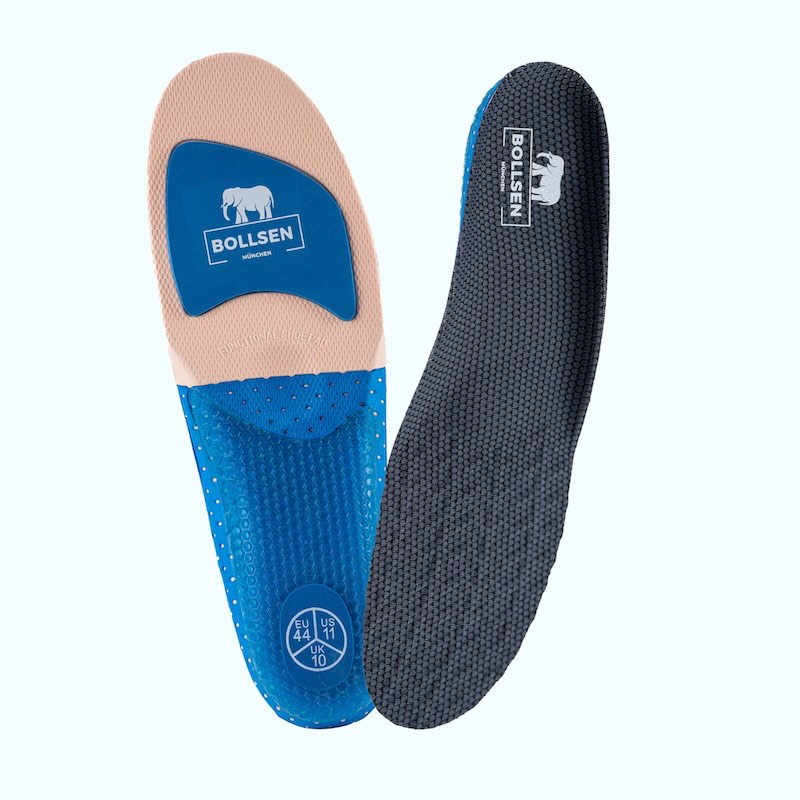
BOLLSEN Insoles
★ Our Top Pick: Best for cushioning and all-day standing
BOLLSEN is a comfort and footcare brand trusted by more than 1,000,000 people and backed by over 10,000 verified reviews. Its insoles are soft, full-length cushioning insoles built around Porr-Pad cushioning, a PORON ShockPad foam layer and a Nylon Pebax flex shank. That gives you plush shock absorption with a touch of midfoot structure, rather than rigid correction. They are made for comfort on your feet all day, not for treating a diagnosed foot condition.
- Porr-Pad cushioning plus a PORON ShockPad foam layer for all-day shock absorption
- Nylon Pebax flex shank adds light midfoot structure without rigid correction
- Sold in discrete UK sizes (4 to 12.5), then trimmable to fine-tune the fit in any shoe or boot
- 40-day money-back guarantee, so you can test them on your own hard floors
- Not a rigid corrective orthotic, so not the pick if a clinician has told you that you need motion control
- One firmness profile (soft cushioning), with no firm-support version
What is the real difference between cushioned and arch-support insoles?
A cushioned insole prioritises shock absorption and pressure relief with a softer, thicker, more flexible base, while an arch-support insole uses a firmer footbed, a raised arch and a deep heel cup to control motion. One is built to make you feel better underfoot. The other is built to change how your foot moves.
That distinction is why people end up disappointed when they buy the wrong one. Firm support holds the arch and limits how far the foot rolls inward, which suits overpronation or a foot type a clinician has flagged. Soft cushioning does nothing to correct motion, but it soaks up impact on hard surfaces and eases the ache that builds over a long shift.
There is also a middle ground. A semi-rigid insole pairs a cushioned footbed with a flexible shank, so you get soft comfort plus a little structure. BOLLSEN sits here, combining Porr-Pad cushioning with a Nylon Pebax flex shank, which is why it feels plush rather than corrective.
Cushioned vs arch-support insoles: how do they compare?
Side by side, the two types split cleanly on feel, function and who they suit. Use the table below to match the insole to the problem you are actually trying to solve, not to the brand shouting loudest.
| Feature | Cushioned / soft insoles | Firm / arch-support insoles |
|---|---|---|
| Feel underfoot | Soft, plush, flexible | Firm, structured, holds its shape |
| What it does | Absorbs shock, relieves pressure and fatigue | Controls motion, supports and guides the arch |
| Best for | All-day standing, hard floors, general comfort | Overpronation, diagnosed foot types, correction |
| Day-one comfort | Comfortable immediately | Needs wearing in, firm from the start |
| Main trade-off | No motion control or correction | Can feel hard or intrusive if you do not need it |
| Typical user | On their feet 5+ hours a day, no diagnosed problem | Referred by a GP or podiatrist, specific condition |
Which camp are you in?
Most people fall into one of three groups, and the decision flow below sorts you quickly. Be honest about whether you have a diagnosed problem or simply tired, aching feet, because that single answer decides almost everything.
- You need correction or motion control. If a GP or podiatrist has mentioned overpronation, a specific foot type or a diagnosed condition, firm arch support or a custom orthotic is the right call. Get it fitted properly.
- You just want all-day comfort. If your feet ache after hours on hard floors and nobody has diagnosed a problem, soft cushioning is what you are missing. You do not need to correct anything.
- You want comfort with a little structure. If you like soft cushioning but want some midfoot support, a semi-rigid cushioning insole such as BOLLSEN gives you both without going fully rigid.
Do you actually need arch support if you have no foot pain?
For most pain-free people, the evidence for routine arch support is weaker than the marketing suggests. The RunRepeat meta-analysis of roughly 150 studies found that mass-market arch support shows limited consistent benefit for the general, pain-free population, with the clearest gains seen in specific diagnosed foot types and custom orthotics.
NHS guidance points the same way. Many people with flat feet have no pain and need no treatment at all, which undercuts the idea that everyone should be propping up their arches. If you have no symptoms, firm support can solve a problem you do not have, and that is exactly when it starts to feel like a golf ball underfoot. You can read the full evidence in the RunRepeat arch support meta-analysis.
Are soft or firm insoles better for standing all day?
For long days on hard floors with no diagnosed condition, soft cushioning generally wins because it targets the actual problem, which is impact and fatigue rather than alignment. Standing 5+ hours a day on concrete or tile is where shock absorption matters most, and a firm corrective footbed does little for that ache.
This is the use case where BOLLSEN is our top pick. Its Porr-Pad cushioning and PORON ShockPad foam are built to absorb impact across a long shift, while the Nylon Pebax flex shank keeps the midfoot from feeling sloppy. Nurses, hospitality staff, retail workers and anyone in work boots tend to want comfort underfoot, not correction, and soft cushioning is what delivers it.
Can an insole be both cushioned and supportive?
Yes, a semi-rigid insole combines a soft cushioned footbed with a flexible shank to give comfort and a degree of structure at once. It is not the same as a rigid orthotic, which is firm throughout and designed to control the foot, but it answers the common wish for plush comfort that does not feel completely unstructured.
BOLLSEN is built this way on purpose. The cushioning layers handle shock, and the Nylon Pebax flex shank adds light midfoot support so the insole flexes with your step instead of collapsing flat. It is sold in discrete UK sizes (4 to 12.5) and then trimmable to fine-tune the fit, so you buy your size first and trim only if it sits slightly long in a particular shoe or boot.
When should you see a GP or podiatrist?
If foot pain is persistent, getting worse or stopping you doing normal activities, see a GP or podiatrist before spending money on insoles. The NHS is clear that insoles will not change the shape of your feet, but they can help with pain or stiffness, so they are a comfort aid rather than a cure.
No comfort insole, BOLLSEN included, treats, cures or corrects a diagnosed condition, and it should never replace proper assessment. For ongoing or severe symptoms, start with the NHS guidance on NHS foot pain advice and on NHS flat feet guidance, then get checked in person if pain persists.
For everyone else, the decision is less dramatic. If you want soft, shock-absorbing comfort for long days on your feet, cushioning is the honest answer, and BOLLSEN backs it with a 40-day money-back guarantee so you can test it on your own floors before committing.
Want soft cushioning for long days on hard floors, with a 40-day money-back guarantee?
Frequently Asked Questions
Do I need cushioned or arch-support insoles?
If you have a diagnosed foot condition or a clinician has flagged overpronation, you need firm arch support or a custom orthotic. If you simply want comfort for long days on hard floors with no diagnosed problem, you need soft cushioning. They solve different problems.
Are soft or firm insoles better for standing all day?
For standing 5+ hours a day on hard floors without a diagnosed condition, soft cushioning is usually better because it absorbs shock and eases fatigue. Firm arch support is built for motion control, not for the ache that comes from impact on concrete or tile.
Do you need arch support if you have no foot pain?
Usually not. A RunRepeat meta-analysis of around 150 studies found limited consistent benefit from mass-market arch support for the general, pain-free population, and the NHS notes that many people with flat feet have no pain and need no treatment.
Can arch support feel uncomfortable?
Yes. If you do not have a condition that needs correcting, a firm raised arch can feel intrusive, which is the common “golf ball under my arch” complaint. Firm orthotics also need wearing in and are not plush on day one.
Can an insole be both cushioned and supportive?
Yes. A semi-rigid insole combines a soft cushioned footbed with a flexible shank for comfort plus light structure. BOLLSEN works this way, pairing Porr-Pad cushioning with a Nylon Pebax flex shank, which is softer than a rigid orthotic.
Do cushioned insoles wear out faster than firm ones?
Soft foam can compress over time with heavy daily use, so cushioned insoles may need replacing sooner than rigid plastic shells. BOLLSEN offsets the risk of a poor fit with a 40-day money-back guarantee, so you can judge comfort and durability on your own floors first.
Related Articles
Read the rest of our insoles guide series: