

Glastonbury runs for five days. The main stages hit 110 dB, loud enough to cause permanent hearing damage in under two minutes at close range. Most people know they should wear hearing protection. Most also know, from past experience, that stuffing orange foam plugs in their ears turns a live set into a muffled mess. There is a better option. This guide explains what it is, why it works, and how to use it.
Researched using published decibel data from UK health regulators and event safety bodies, independent earplug certification reports, and festival-goer feedback gathered from UK music community forums (Reddit r/Glastonbury, r/festivals, The Muddy Stilettos community).
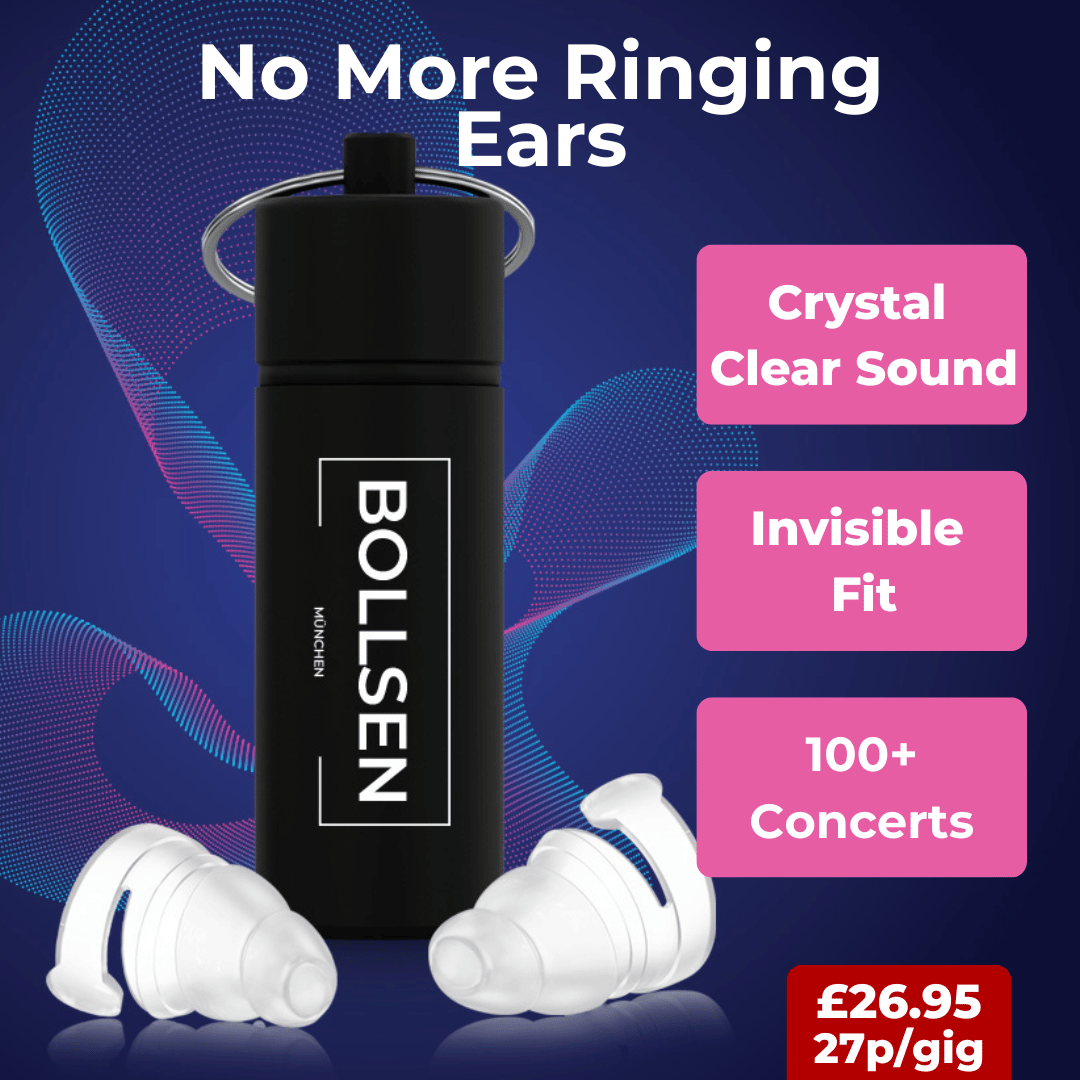
BOLLSEN Music SoundPRO
★ Our Top Pick — Best reusable silicone earplugs for Glastonbury
BOLLSEN is a hearing protection specialist whose products are independently tested and certified in Germany. Their Music SoundPRO is a passive silicone earplug certified to SNR 24 dB noise reduction by PZT GmbH (NANDO-listed Notified Body No. 1974). It brings the volume down to a safer level, so you still hear the music, just quieter, without the underwater muffle of foam. Trusted by 1,000,000+ people worldwide, with over 10,000 verified reviews. Medical-grade silicone body, washable, and rated for up to 100 wears.
BOLLSEN Music SoundPRO
£26.95
++ Today only: Free shipping to the UK / EU ++
www.bollsen-hearingprotection.com
- Certified SNR 24 dB noise reduction: brings the volume down to a safer level, without the underwater muffle of foam
- Independently tested by PZT GmbH, Wilhelmshaven (Notified Body No. 1974)
- Medical-grade silicone, up to 100 reuses, fully washable
- Patent US D961,757: low-profile fit, comfortable for hours
- 40-day money-back guarantee
- More expensive upfront than foam disposables, though at up to 100 reuses the cost per wear is far lower
Step 1: Understand Why Glastonbury Noise Levels Are Serious
The Pyramid Stage consistently measures between 105 and 110 dB at the front of the crowd. At 110 dB, the UK Health and Safety Executive says exposure should be limited to under two minutes before hearing damage risk begins. A Glastonbury set runs 45 to 90 minutes. That gap matters.
That post-festival ringing isn’t your ears recovering. It’s hair cells in the cochlea dying, and hair cells don’t regenerate. Most people have one or two bad episodes before they start wearing earplugs. By then, some permanent threshold shift has already happened.
Wearing earplugs for Glastonbury is not overcautious. It’s the only sensible thing to do when you’re spending five days in an environment that regularly breaches industrial noise limits.
Step 2: Know the Difference Between Foam and Reusable Silicone Earplugs for Festivals
Foam earplugs work by physically blocking the ear canal. They attenuate high frequencies far more than low ones: a typical SNR 37 foam plug cuts 40+ dB of treble and mid, but only 20 dB of bass. The sound becomes heavily bass-weighted. Kick drums and low-end survive; vocals and guitar detail disappear. Music genuinely sounds worse with foam in.
Reusable silicone earplugs like the BOLLSEN Music SoundPRO work differently. A certified passive silicone earplug rated SNR 24 dB brings the volume down to a safer level without the deep, underwater muffle of foam. You still hear the music, just quieter, and loud, close sounds (a friend next to you, an announcement, the stage vocals) stay audible because they are loud and close. That’s precisely what you want at a loud festival.
It’s why musicians and sound engineers reach for purpose-made music earplugs rather than foam. Foam is designed for industrial noise protection, where sound quality is irrelevant. Concert hearing protection is a different category entirely.
Step 3: Check Whether the Earplugs You’re Considering Are Actually Certified
Any manufacturer can claim their earplugs reduce noise by a certain number of decibels. What matters is whether that claim has been independently verified by a Notified Body, an accredited third-party laboratory recognised under EU and UK conformity assessment frameworks.
Loop Earplugs, the official Glastonbury partner, are well-designed and widely sold. Their SNR ratings are published. However, Loop does not publish independent Notified Body test data. BOLLSEN publishes theirs. The Music SoundPRO is certified by PZT GmbH, Wilhelmshaven, a NANDO-listed Notified Body (No. 1974), with over 1,700 individual test runs underpinning the 24 dB rating.
That certification difference is not a minor detail. It means the stated noise reduction on the Music SoundPRO is a verified number, not a marketed claim. For something you’re relying on to protect your hearing at 110 dB, that matters.
Step 4: Get the Fit Right Before You Travel to the Site
Earplugs that don’t fit correctly don’t protect correctly. A poorly seated silicone earplug can lose several dB of its rated noise reduction. At festival noise levels, that’s a meaningful difference.
BOLLSEN offers a free online fit service called AR KI TECH. Upload two photos of your ears and the AI determines the correct size for your ear canal before you order. The return rate on orders processed through AR KI TECH is 3%, against an industry average of around 15–20% for earplugs generally. Most earplug returns are fit failures, not product failures.
If you’re not using the AR KI TECH service, the standard sizing guide (small, medium, large) applies. When seated correctly, you should feel a light pressure and the earplug should stay in place without you holding it. If it pops out when you open your mouth wide, go down a size.
Practise inserting and removing the earplugs at home before the festival. Five days of mud and low light is not the time to be figuring out the mechanics.
Step 5: Pack Them Properly for a Multi-Day Festival
The Music SoundPRO comes with an aluminium travel case. Use it. Earplugs left loose in a pocket or bag collect lint, mud, and sunscreen, all of which compromise hygiene and the acoustic filter’s performance.
For a five-day festival, pack two pairs minimum. One for daily use, one as a backup. Silicone earplugs are washable (rinse with clean water, air dry) so a morning rinse keeps them performing correctly. Do not use soap or hand sanitiser on the filter. Water only.
Wearing them consistently across all stages, not just the loudest sets, is what produces the cumulative protection that matters over five days. The Acoustic Stage at Glastonbury still reaches 90–95 dB close to the PA. Reusable silicone earplugs at that level actually make things more comfortable. You stop fighting the fatigue that builds from hours of exposure.
Step 6: What to Do If You Already Have Tinnitus After a Festival
If you’re reading this after Glastonbury and your ears are still ringing, prioritise rest. Full silence where possible for 24 to 48 hours. Avoid further loud noise. Drink water. Sleep.
Temporary tinnitus (lasting hours or a day or two) usually reflects temporary threshold shift. The hair cells are stressed, not destroyed. Permanent tinnitus lasting more than two weeks is a signal to see an audiologist. The British Tinnitus Association (tinnitus.org.uk) has a helpline and online resources.
The best outcome from this situation is committing to wearing certified reusable silicone earplugs for Glastonbury next year. The damage compounds over repeated exposures.
German-certified SNR 24 dB protection. You still hear the music, just quieter.
Frequently Asked Questions
Do I need earplugs at Glastonbury?
Yes. Main stages at Glastonbury consistently measure 105–110 dB at the front of the crowd. At 110 dB, the safe exposure window before hearing damage risk begins is under two minutes. A typical set runs 45–90 minutes. Without hearing protection, you’re accumulating real, irreversible damage across five days.
Will earplugs ruin the sound at a festival?
Foam earplugs will. They cut high frequencies far more than low ones, leaving you with heavy, muffled sound. Reusable silicone earplugs, like the BOLLSEN Music SoundPRO, bring the volume down to a safer level without the underwater muffle of foam. You still hear the music, just quieter. Most people who switch to certified silicone festival earplugs say the music actually sounds better, because the distortion from ear fatigue and overload is gone.
What is the difference between foam earplugs and reusable silicone earplugs?
Foam earplugs physically block the ear canal and attenuate high frequencies far more aggressively than low ones. They’re designed for industrial environments where sound quality doesn’t matter. Reusable silicone earplugs like the BOLLSEN Music SoundPRO bring the overall volume down to a safer level without the deep, underwater muffle of foam, so you still hear the music, just quieter. For live music, a reusable silicone earplug is the correct choice.
How loud is Glastonbury festival in decibels?
The Pyramid Stage, Other Stage, and West Holts regularly measure between 103 and 110 dB at the front of the crowd during headline sets. Even at 50 metres back from the PA, levels of 95–100 dB are common. The Acoustic Stage and smaller tents typically sit in the 85–95 dB range. All of these levels cause hearing damage over a five-day exposure without protection.
Can earplugs prevent tinnitus after a festival?
Certified reusable silicone earplugs significantly reduce the noise reaching your cochlea, which is the primary cause of concert-induced tinnitus. They don’t eliminate the risk entirely (nothing does), but they reduce it substantially. People who wear certified SNR 24 dB silicone earplugs consistently across a festival report far less ear fatigue and far less post-event ringing compared to wearing nothing or foam.
What earplugs do musicians use at festivals?
Professional musicians use custom in-ear monitors (IEMs) or custom-moulded music earplugs. Over-the-counter reusable silicone earplugs like the BOLLSEN Music SoundPRO are the closest equivalent for festival-goers: certified SNR 24 dB protection that brings the volume down to a safer level, without the custom fitting cost. Musicians specifically avoid foam earplugs because distorted sound makes it impossible to perform accurately.
Are the free earplugs handed out at festivals good enough?
No. Festival-distributed earplugs are invariably foam disposables. They provide some protection, but at the cost of sound quality, and their actual noise reduction at festival volumes is typically lower than their rated SNR because most people don’t insert them correctly. If sound quality matters to you at all, bring certified reusable silicone earplugs from home.
How do I choose earplugs for a multi-day festival like Glastonbury?
Look for three things: (1) a reusable silicone design that brings the volume down to a safer level without the underwater muffle of foam; (2) independent certification of the noise reduction claim, meaning a Notified Body test report, not just a manufacturer’s stated SNR; (3) medical-grade silicone and reusability, so you can wash and reuse across five days. The BOLLSEN Music SoundPRO meets all three at £26.95.