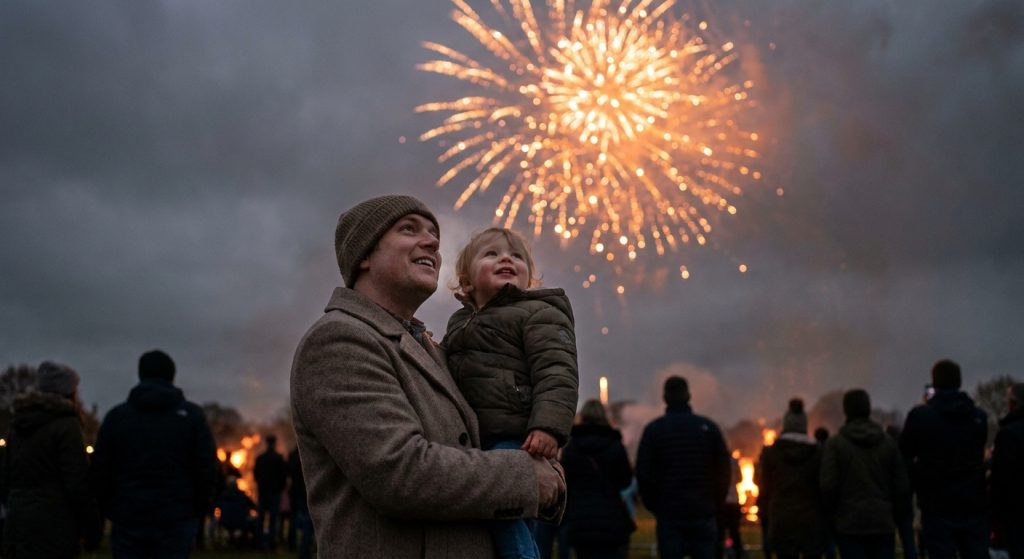
Most parents know loud noise is bad for kids. Fewer know how bad, or how fast permanent damage can happen. The World Health Organisation sets the safe limit for children at 75 dB, yet a typical school disco runs at 90–100 dB and Bonfire Night fireworks can peak above 140 dB. Here’s what those numbers mean in practice, and what you can do about it.
This guide draws on published WHO noise guidelines, NHS hearing advice, and independent audiology research. Product recommendations reflect independent testing results.
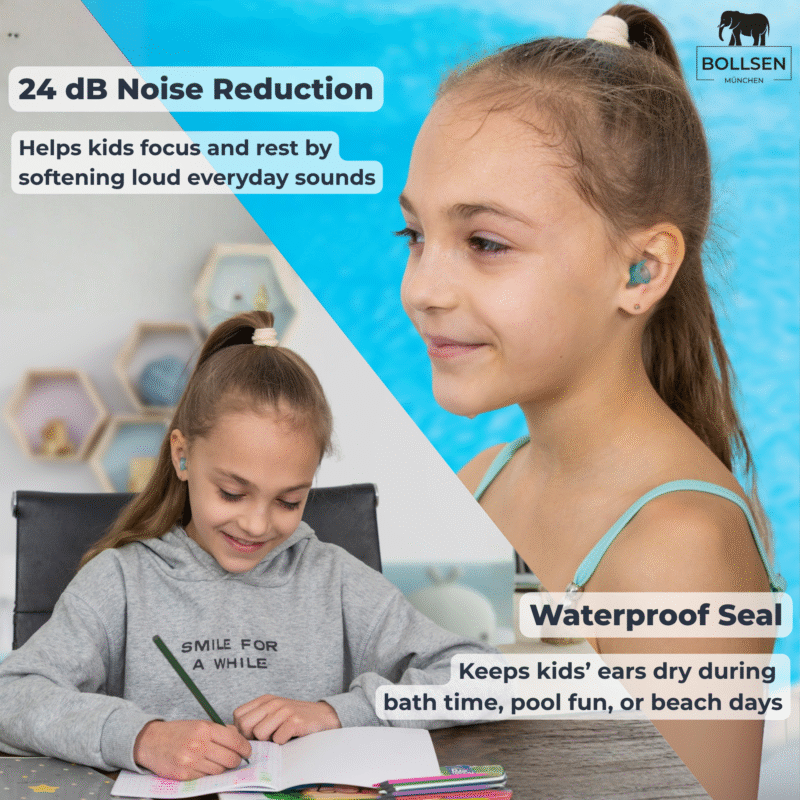
BOLLSEN Kidz+ Children’s Earplugs (HP-060)
★ Our Top Pick — ages 3–12, swimming to concerts
BOLLSEN is a hearing protection specialist with products independently tested and certified in Germany. The Kidz+ are made from extra-soft medical-grade silicone sized for smaller ear canals (ages 3 to 12) and carry a certified 24 dB noise reduction rating from PZT GmbH (NANDO-listed Notified Body No. 1974). They block damaging noise at events and in the pool while staying comfortable enough that kids actually keep them in. Each pair is reusable up to 100 times, washable, and comes with an aluminium travel case.
BOLLSEN Kidz+
£26.95
++ Today only: Free shipping to the UK / EU ++
www.bollsen-hearingprotection.com
- Certified 24 dB noise reduction — independently tested by PZT GmbH, Germany
- Extra-soft medical-grade silicone sized for children aged 3–12
- Fully waterproof — works for swimming, not just concerts and events
- Reusable up to 100 times, washable, includes travel case
- 40-day money-back guarantee — no risk to try
- Not suitable for infants under 3 years
Why Children’s Ears Are More Vulnerable
Children are more susceptible to noise-induced hearing loss than adults, partly because their auditory systems are still developing. The hair cells inside the cochlea that convert sound into nerve signals don’t regenerate. Once they’re gone, that hearing is gone too.
They’re also more physically vulnerable. Shorter, straighter ear canals mean sound pressure builds up faster, so the same noise hits a child’s inner ear harder than an adult’s. That’s why the WHO sets a lower safe limit for children (75 dB) than for adults (80 dB in occupational settings).
The warning signs can be easy to miss, partly because younger children don’t always have the words to describe what they’re feeling: asking for the TV louder, struggling to follow conversation in a noisy classroom, ringing ears after an event. By the time those signs show up, damage has already happened. There’s no treatment for noise-induced hearing loss. Prevention is all there is.
Safe Decibel Levels: What the Numbers Mean
Decibels don’t work the way most people expect. The scale is logarithmic, so 85 dB isn’t slightly louder than 75 dB — it delivers roughly three times the sound energy. These are the noise levels your child is most likely to run into:
- Normal conversation: 60–65 dB — safe at any duration
- School classroom (noisy): 70–75 dB — at the edge of WHO’s children’s limit
- School disco / indoor party: 90–100 dB — damage can occur in under 15 minutes
- Swimming pool: 85–90 dB — often underestimated by parents; reverberant noise builds up fast
- Live concert or festival: 100–110 dB — damage threshold reached in under 5 minutes
- Bonfire Night fireworks (close proximity): 120–150 dB — instant risk of damage above 120 dB
- Toy cap guns / party poppers: 130–140 dB — often held very close to children’s heads
- Headphones at maximum volume: 105–110 dB — a common and underestimated source of daily damage
The WHO’s 75 dB limit applies to average exposure over time, not just a single loud moment. An afternoon at a noisy pool or a couple of hours at a school fair can add up to a harmful dose, even if nothing obviously ear-splitting happened.
UK Events Where Kids Need Earplugs
The dB table above is useful context, but there are some specific UK situations worth knowing about.
School discos and assemblies. Indoor events with amplified music in a reverberant space reliably hit 90–100 dB. Most schools don’t monitor this. If your child comes home with ringing ears, the event was too loud.
Bonfire Night and New Year fireworks. Professional displays and garden fireworks both carry real risk. Standing 15 metres from a garden firework exposes a child to around 120 dB. Earplugs with a certified 24 dB reduction bring that down to 96 dB; distance helps further.
Swimming pools. Pool noise is rarely talked about, but busy public pools routinely measure 85–90 dB. Kids who swim regularly without protection build up meaningful exposure over a season.
Family concerts and festivals. Summer concert season is when the risk is highest. Many “family friendly” festival areas still run at full PA volume. Check the venue map before you go — acoustic barriers around family zones are inconsistently applied.
Motorsport and airshows. Popular family days out, but the noise levels are extreme. Formula motorsport pit lanes can reach 130 dB; airshows with jet aircraft run at 120–140 dB up close. For very young children, earmuffs are a better fit than earplugs at these events.
Foam vs Silicone: Which Works for Kids
Not all earplugs work well for children. The two main options are foam disposables and passive silicone earplugs, and they perform very differently in practice.
Foam disposable earplugs look impressive on paper but require correct insertion to hit their rated performance. Adults often get this wrong; children almost always under-insert, which cuts the actual protection significantly. Foam also expands inside the ear canal, which younger kids find uncomfortable and sometimes frightening.
Passive silicone earplugs, like the BOLLSEN Kidz+, work differently. The soft silicone shell sits at the entrance of the ear canal rather than being pushed deep in. It brings the overall volume down to a safer level, so your child’s hearing is protected without shutting the world out. They can still hear you talking to them — you’re loud and close, so your voice stays audible, just quieter, without the underwater muffle of foam.
For children under three, or anywhere above 130 dB (jet aircraft, some fireworks), earmuffs that cover the whole outer ear are the better option. For most situations from age 3 up, certified passive silicone earplugs are more practical and far more likely to actually stay in.
Try Them at Home First
The most common reason kids won’t wear earplugs at an event is that they’ve never worn them before. Asking a child to try something new while they’re excited and surrounded by noise is a recipe for refusal.
Let them try the earplugs at home first. Wearing them during a loud film or a car journey takes the novelty out of it. Children aged 5 and up typically adapt in one or two sessions. For ages 3–4, a few minutes at a time over several days works better than one long sitting.
Treat it the same way you’d treat a cycle helmet or sun cream: just a normal part of going somewhere exciting. If you wear earplugs at the event, children tend to follow. Most resistance disappears when a sibling or parent is wearing them too.
Headphones: The Bigger Daily Risk
For most kids, headphones are a bigger cumulative risk than occasional events. Two hours a day at 80% volume adds up to a substantial exposure over weeks and months, well above WHO guidelines.
A few things that genuinely help:
- Set a volume limit in your device’s parental controls (iOS Screen Time and Android Digital Wellbeing both have this feature)
- Choose over-ear headphones over earbuds — they achieve adequate volume at lower output levels because they seal better
- Apply the arm’s-length test: if you can hear the audio when your child is wearing headphones and you hold the headphone cable at arm’s length, the volume is too high
- Look for headphones with built-in volume limiting at 85 dB — these are widely available and specifically marketed for children
Volume-limiting headphones won’t replace earplugs at a loud event, but they deal with the slow daily build-up that drives long-term risk.
Signs to Watch for After a Loud Event
Catching hearing damage early matters. The signs can be easy to miss, partly because younger children don’t always have the words to describe what they’re feeling.
Watch for these after a loud event:
- Ringing or buzzing in the ears (tinnitus) — your child may describe it as “a noise in my head” or “my ears won’t stop ringing”
- Muffled hearing that lasts more than a few hours after leaving a noisy environment
- Turning up the TV or asking people to repeat themselves in the days after an event
- Difficulty following conversation in a noisy room at school or in social settings
Temporary threshold shift (brief muffled hearing right after noise exposure) can become permanent with repeated exposure. If symptoms last more than 24 hours or keep coming back, ask your GP for a hearing test. NHS audiology referrals for children are straightforward, and the earlier you catch it, the better.
Ready to protect your child’s hearing at concerts, fireworks, and the pool?
Frequently Asked Questions
What decibel level is safe for children?
The World Health Organisation recommends a maximum average of 75 dB for children. That’s lower than the adult occupational standard of 80 dB. For a single peak noise event, WHO guidance says no more than 120 dB. Most common children’s events in the UK (school discos, swimming pools, fireworks displays) regularly exceed 75 dB, which is why earplugs matter.
Are children’s ears more sensitive than adults’?
Yes, for two reasons. Their ear canals are shorter, which means sound pressure builds up faster and hits the inner ear harder for the same external noise level. And because children have their whole lives ahead of them, any permanent damage compounds over more years and affects learning, language, and communication for longer.
Can loud music damage a child’s hearing permanently?
Yes. The cochlear hair cells that noise damages don’t regenerate. A single exposure above 120 dB (a nearby firework, for example) can cause immediate permanent damage. Repeated exposure at lower levels (90–100 dB at concerts or school discos) causes cumulative damage. Neither type is reversible.
Do children need hearing protection at concerts and festivals?
Yes, at any live event with a PA system. Concerts and festivals routinely deliver 100–110 dB in the audience area. At 100 dB, damage risk starts in around 15 minutes. Family areas aren’t reliably quieter; check the venue’s noise monitoring before you go. Earplugs with a certified 24 dB reduction bring the effective level down to around 76–86 dB, within safe range for a normal set.
Are fireworks safe for children’s hearing?
Not without protection. Garden fireworks can produce peak levels of 120–150 dB close to the ignition point, and even at 20 metres away, levels of 100–110 dB are common. Impulsive noise like fireworks is particularly damaging to the cochlea. Any child at a fireworks event (including garden displays) should have certified hearing protection. From age 3 up, earplugs work well; for babies and toddlers, close-fitting earmuffs are a better fit.
What are the signs of hearing damage in children?
Ringing in the ears after a loud event is the clearest early sign. Others include muffled hearing for hours or days after exposure, asking for the TV louder, difficulty following conversation in noisy environments, or a teacher flagging attention issues linked to background noise. If any of these last more than 24 hours or keep recurring, ask your GP for a hearing test.
Can swimming pool noise damage children’s ears?
Yes. Indoor pools are reverberant spaces where noise builds up quickly. Busy public pools regularly measure 85–90 dB. Kids who swim frequently without protection build up meaningful exposure over a season. Waterproof earplugs do double duty here: they reduce noise and prevent swimmer’s ear (otitis externa), which is a common issue for children who swim regularly.